
“How long until my child speaks Dutch?”
It’s a question I hear frequently from expat parents in Amsterdam. Usually during parent-teacher meetings and often with a worried look. The honest answer is that it depends. Age, how many hours of Dutch your child hears, personality and confidence all play a part.
But there are clear patterns. After seven years in a Dutch classroom (and having been the expat kid myself) I can tell you that knowing them takes a lot of worry away. So how long does it take a child to learn Dutch? In this post you’ll find realistic timelines for every age, what’s completely normal for expat kids and when it’s worth having a chat with the teacher.
In short
- Most children in groep 1 and 2 chat with friends in Dutch within about 6–12 months.
- “School Dutch” (the words for reading, maths and topic lessons) takes several years to catch up fully.
- A quiet start is normal. Understanding always comes before speaking.
How long does it take a child to learn Dutch? It depends on two kinds of Dutch
Every child learns two kinds of Dutch at the same time:
- Playground Dutch: chatting and joining in with games. This usually feels “ready” first.
- School Dutch: the words for reading, maths and topic lessons. Think of verhaaltjessommen (story sums) or instructions like “zet een kring om het goede antwoord”. This takes longer.
Research on second language learning shows the same pattern. Children often reach everyday conversation level within about 2 years while academic language can take 5–7 years (Cummins, via EdTech Books). So if your child chats away with friends but finds schoolwork harder, that’s completely normal!
Realistic timelines by age
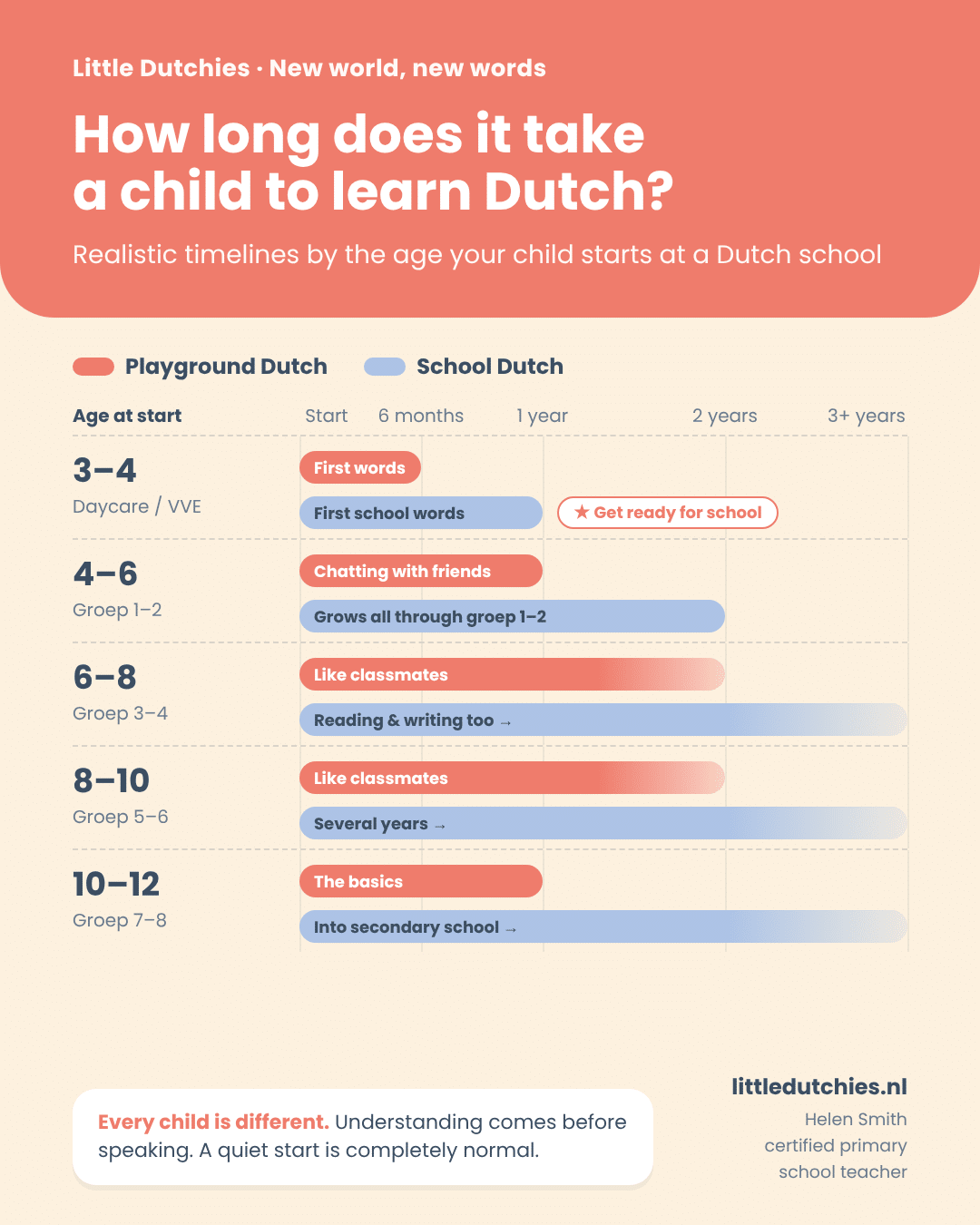
Here’s a quick overview for expat kids in a Dutch school. The ages are your child’s age when they start at a Dutch daycare or school. You’ll find more detail per age below.
| Age at start | Where | Everyday Dutch | School Dutch |
|---|---|---|---|
| 3–4 | Daycare, peuterspeelzaal or VVE | First words after about 3–6 months | First school words: routines, colours and stories |
| 4–6 | Groep 1–2 | Chatting with friends within 6–12 months | Grows all through groep 1–2 |
| 6–8 | Groep 3–4 | Simple Dutch within a few months, like classmates in 1–2 years | Learning to read and write at the same time |
| 8–10 | Groep 5–6 | Simple Dutch in 3–6 months, like classmates in 1–2 years | Several years to catch up fully |
| 10–12 | Groep 7–8 | The basics in the first year | Keeps growing into secondary school |
Ages 3–4: daycare or peuterspeelzaal
- First months: mostly listening and watching.
- Around 3–6 months: understands routines and simple instructions.
- Then: first words and little phrases like “mag ik”, “nee” and “klaar!”
How fast this goes depends a lot on how many days a week your child hears Dutch.
Daycare and peuterspeelzaal already work on school Dutch. In voorschoolse educatie (VVE) children follow national learning goals for young children set by SLO, the Dutch curriculum institute. Think of words for daily routines, colours, shapes and first stories. A child who knows these words walks into groep 1 with a real head start.
Get ready for school
That’s exactly why I’m starting Get ready for school: a small playful group program for 3-year-olds that builds the school Dutch they need for groep 1. Send me a message and I’ll let you know when the next group starts.
Ages 4–6: kleuterklas (groep 1 and 2)
- First weeks or months: a silent period is completely normal.
- Around 6–12 months: many children have small chats with friends.
- Second year: they gain more and more speaking confidence.
Dutch five days a week means fast progress. Their vocabulary keeps growing all through groep 1 and 2. This is the stage I teach every week and it’s where play makes the biggest difference.
Ages 6–8: groep 3 and 4
- First few months: simple everyday Dutch.
- Around 1–2 years: chatting as easily as their Dutch classmates.
Older children often pick up everyday Dutch quickly because they can build on the words and skills they already have in their home language. At the same time they’re learning to read and write in Dutch. That’s a lot to take on at once. Be proud of every step.
Ages 8–10: groep 5 and 6
- First weeks: often in a newcomers class (nieuwkomersklas or taalklas) to learn the basics.
- Around 3–6 months: simple everyday Dutch.
- Around 1 year: ready to join a regular class.
- Around 1–2 years: chatting as easily as their classmates.
Catching up fully with school Dutch can take several years. That’s completely normal.
Ages 10–12: groep 7 and 8
- First year: learning the basics, often in a newcomers class.
- By the end of groep 8: school Dutch usually hasn’t fully caught up yet and that’s normal. Learning simply continues in secondary school (middelbare school).
Children this age learn fast but they can also feel more self-conscious about making mistakes.
Tip: ask the school how they take your child’s time in the Netherlands into account in the school advice for secondary school.
Why is my child so quiet? The silent period
Many parents worry when their child says hardly a word of Dutch in the first weeks or months. Please don’t! Understanding always comes before speaking. A quiet child is often a child who is listening, collecting words and waiting until they feel safe enough to try them out.
I know this feeling all too well. When I moved from England to the Netherlands at eight I spent my first weeks mostly watching. What helped me was one teacher who sat with me one-on-one. That’s still the heart of what I do today.
What helps your child learn Dutch faster
- More hours of Dutch: playdates (speelafspraakjes) with Dutch classmates, sports clubs and Dutch children’s TV like Sesamstraat all count.
- A strong home language: keep reading and talking in your own language. Children build their Dutch on the words they already know.
- Dutch that feels safe and fun: songs, picture books from the library (OBA membership is free for children) and games. You don’t need perfect Dutch to help.
- One-on-one attention: in a class of 20+ children there’s little time to practise speaking. A few minutes of focused attention each day makes a big difference.
When to talk to the teacher
If your child shows very little understanding after around 6 months of daily Dutch or also finds their home language hard, have a chat with the teacher. Sometimes something else is going on with hearing or speech. A logopedist (speech therapist) can help.
Does your child understand Dutch well but still hardly speaks it after about a year? Then it’s often not about words anymore but about confidence. That’s exactly what my Bridge Builder expedition is for. Through play we practise building sentences step by step until your child dares to use them on the playground. It’s still good to mention it to the teacher too.
Curious where your child is on their Dutch journey?
Every child’s path in their Great Dutch Adventure is different. In my Assessment Playdate I visit you at home in Amsterdam, Amstelveen or Diemen. I play with your child and find out exactly where they are. Afterwards you get clear advice on the next steps. That could be one of our Expeditions or a few simple things you can do at home. It all starts with a free Virtual Coffee where we get to know each other.
Frequently asked questions
Is it harder for older children to learn Dutch?
Not harder, just different. Older children often learn everyday Dutch quickly because they can build on their home language. They do have more school Dutch to catch up on and can feel more shy about making mistakes.
Should we speak Dutch at home?
Keep speaking the language you feel most at home in. A rich home language helps your child learn Dutch. You can add Dutch in a playful way with songs, books and games.
My child understands Dutch but won’t speak it. Is that normal?
Yes, very. This is the silent period. Give it time, keep Dutch low-pressure and celebrate every word they try.
About the author
Helen Smith is a certified Dutch primary school teacher and the founder of Little Dutchies. She moved from England to the Netherlands when she was eight and now helps expat children in Amsterdam, Amstelveen and Diemen find their voice in Dutch through one-on-one play. Read Helen’s story